

However, after years of working with chilled water systems in commercial buildings, industrial facilities, and retrofit projects, I can say this clearly: chilled water piping does not just benefit from insulation—it depends on it.
To understand why, we need to look beyond surface-level assumptions and focus on how cold pipe insulation actually works in real-world conditions.
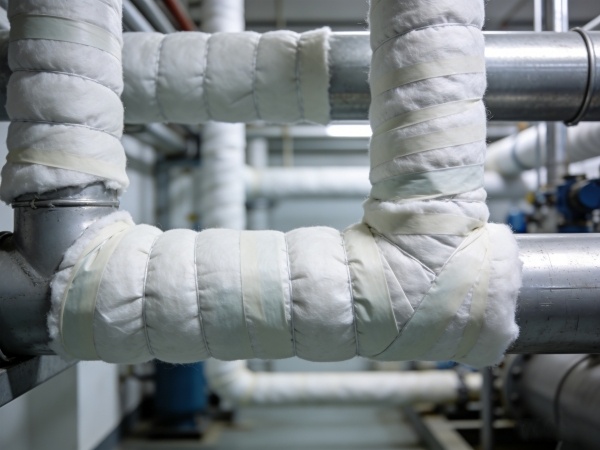
In chilled water systems, pipes routinely operate at temperatures well below the surrounding ambient air—often between 4°C and 7°C (39°F–45°F). When a cold surface is exposed to warmer, moisture-laden air, physics takes over.
From my experience, the primary purpose of chilled water pipe insulation is not to keep cold water cold. It is to control heat gain and prevent condensation, two factors that directly affect system efficiency, reliability, and building safety.
Uninsulated or poorly insulated chilled water piping allows continuous heat transfer from the environment into the pipe. This increases cooling load, forces chillers to work harder, and reduces overall energy efficiency. More importantly, it creates surface temperatures that fall below the dew point of the surrounding air—setting the stage for condensation.
In short, cold insulation is a system protection strategy, not a comfort upgrade.
Condensation is where most beginners underestimate the seriousness of the problem. Many assume a little surface moisture is harmless. In reality, condensation is one of the most destructive forces in chilled water piping systems.
When chilled water pipes are not properly insulated, moisture continuously forms on the pipe surface. Over time, this leads to:
? Water dripping onto ceilings, floors, and electrical systems
? Mold and mildew growth in concealed spaces
? Accelerated corrosion of metal piping and pipe supports
? Damage to insulation, finishes, and building structures
I have seen entire ceiling systems replaced simply because condensation from uninsulated chilled water lines went unnoticed for months. The repair costs dwarfed what proper cold pipe insulation would have cost initially.
This is why condensation control—not temperature retention—should always be the first design consideration in chilled water pipe insulation.
Effective cold pipe insulation works by addressing two challenges simultaneously: thermal control and moisture control.
First, insulation reduces heat gain by limiting heat transfer from the surrounding environment into the chilled water pipe. This helps maintain stable water temperatures and improves the efficiency of chillers, pumps, and control systems.
Second—and more critically—cold pipe insulation incorporates a vapor barrier. In my professional experience, the vapor barrier is often more important than insulation thickness in cold applications.
A properly designed insulation system keeps the outer surface temperature above the ambient dew point, while the vapor barrier prevents water vapor from migrating into the insulation layer. Without this barrier, moisture infiltrates the insulation, degrading its performance and eventually leading to hidden condensation and corrosion under insulation (CUI).
This is why closed-cell insulation materials are so widely used in chilled water applications—they inherently resist moisture ingress and maintain long-term thermal performance.
Over the years, I have evaluated countless insulation failures. Most of them trace back to ignoring a few fundamental requirements.
For chilled water piping, effective cold insulation must provide:
? Low water vapor permeability to prevent moisture ingress
? Adequate insulation thickness to keep surface temperatures above dew point
? Closed-cell structure for long-term performance stability
? Continuous vapor barrier integrity, including joints, fittings, and valves
One common mistake among new designers is selecting insulation based solely on thermal conductivity (K-value). While important, K-value alone does not determine success in cold pipe insulation. Vapor resistance, installation quality, and detailing around penetrations matter just as much—if not more.
In practice, even the best insulation material can fail if seams are poorly sealed or vapor barriers are compromised.
If I had to summarize the most frequent mistakes I see in chilled water pipe insulation projects, they would be these:
Designing for chilled water requires a completely different mindset, with moisture control as the priority.
Humidity levels, air movement, and installation environment all affect condensation risk, yet they are often overlooked.
Valves, flanges, and supports are common failure points when insulation continuity is broken.
Many problems develop inside the insulation system, remaining hidden until structural or corrosion damage has already occurred.
Avoiding these mistakes requires experience, but more importantly, it requires understanding why cold pipe insulation exists in the first place.

Copyright ? 2025ZHEJIANG ZHENSHEN INSULATION TECHNOLOGY CORP.LTD. All rights reserved. 網(wǎng)站備案/許可證號(hào):浙ICP備16010266號(hào)-1